Herbert Block authored a total of 12 books: The Herblock Book (1952), Herblock's Here and Now (1955), Herblock's Special for Today (1958), Straight Herblock (1964), The Herblock Gallery (1968), Herblock's State of the Union (1972), Herblock Special Report (1974), Herblock on All Fronts (1980), Herblock Through the Looking Glass (1984), Herblock at Large (1987), Herblock: A Cartoonist's Life (1993), and Bella and Me (Life in the Service of a Cat) - (1995), updated Herblock: A Cartoonist's Life in paperback with an added chapter and 70 more cartoons (1998).
The Life and Work of the Great Political Cartoonist
by Haynes Jonhson and Harry Katz
This retrospective volume, published to coincide with an exhibition at the Library of Congress celebrating Herb Block’s 100th birthday, illuminates his life and times and reinforces the importance of editorial cartoons as a vital means for expressing political opinion in America.
"From the stock market crash in 1929 through to the new millennium, editorial cartoonist Herbert L. Block, widely known as Herblock, chronicled the nation’s political history, caricaturing thirteen American presidents from Herbert Hoover to George W. Bush. He received three Pulitzer Prizes for editorial cartooning (1941, 1954, and 1979) and was cited in The Washington Post’s Pulitzer for public service during the Watergate investigation (1973). He received the Presidential Medal of Freedom in 1994 and in 2000 the Library of Congress named Herblock a “Living Legend” in recognition of his extraordinary contributions to the nation. No cartoonist or commentator in America did more to educate and inform the American public than Herblock. Political cartoons represent the freedom of expression inherent in American democracy, a powerful symbol of its strength and resilience. Herblock’s drawings forcefully bring back the principal issues and events that shaped our world during the past century."
-James H. Billington, Librarian of Congress. Excerpted from Herblock: The Life and Work of the Great Political Cartoonist
"Herb Block indelibly depicted villains and rogues, corrupt officials and corporate polluters, racists and demagogues. He relentlessly attacked the gun lobby, segregationists, governmental secrecy, abuses of power, religious bigots, sexism , racism and, always, public hypocrisy wherever and whenever it arose. At the same time he ardently fought for civil liberties, for the poor and the oppressed. He always stood for the underdog, and for the everyman and everywoman among us trapped in, or frustrated by, the ever more complicate nature of modern life."
-Haynes Johnson, “The Age of Herblock”. Excerpted from Herblock: The Life and Work of the Great Political Cartoonist
Editorial Reviews
From Publishers Weekly
The diminishing profession of editorial cartooning has been a particularly doleful canary foretelling the decline of the daily newspaper format. In this context, this retrospective of the late cartoonist's work defiantly documents the extraordinary career of a daily visual commentator on American political life. Designed to accompany an exhibit at the Library of Congress, the book briefly outlines the artist's career and its historical context, starting with Herbert Block's early career during FDR's term. His first Pulitzer, in 1941, earned him independence when he came under editorial fire for advocating U.S. entry into WWII. After his own military service, he joined theWashington Post, an association that lasted until his death in 2001. The bulk of the book showcases highlights of the artist's seven-decade career. Politically independent but largely progressive, Herblock is presented as prescient on issues including McCarthyism (a term he coined), civil rights and environmentalism. Herblock's best cartoons do more than provide color commentary on political skirmishes. They manifest characters vividly: his viciously ineffectual Eisenhower brandishes a feather opposite an ax-wielding McCarthy, for instance. The book is accompanied by a DVD containing 18,000 cartoons, a nearly complete collection of Herblock's indispensable oeuvre. (Oct.)
Copyright © Reed Business Information, a division of Reed Elsevier Inc. All rights reserved.
Review
“[A]s this generous selection of cartoons verifies, [Herblock] was drawing his trademark fat-cat big shots and portentous atmospheres (he was a master of shading) virtually from the beginning. Castigated as a knee-jerk liberal, he was really on the side of the little guy, repeatedly pointing out how big labor as well as big business, homegrown demagogues as well as exotic dictators, oppressed the common person.... Herblock’s Post reporter colleague Johnson, cartoon curator Katz, and the man himself, via snippets from his occasional writings, contribute to the text, and a DVD containing more than 18,000 cartoons accompanies the book.” (Ray Olson -Booklist)
From The Washington Post
From The Washington Post's Book World/washingtonpost.com Reviewed by Michael Sims Over the past three centuries, editorial cartoonists have been the watchdogs of political change. Just think of Daumier's lampooning of King Louis-Philippe, or the famous broken snake in the "Join, or Die" cartoon that encouraged barely cooperating American colonies to unite for the common good, or Thomas Nast's sniper attacks on Boss Tweed and Tammany Hall. Nast would have loved Herbert Block, who gained fame as Herblock, the longtime cartoonist for The Washington Post. Like his predecessor, Block united in a single mind irony, outrage and a mastery of symbolism. He knew that there are no more predictable constants in any society than hypocrisy, opportunism and exploitation, and he described the political cartoon as "essentially a means for... puncturing pomposity." This irresistible new book, with commentary by Haynes Johnson and Harry Katz, accompanies a Library of Congress exhibition celebrating the centennial of Block's birth and includes a CD that punctures pomposity with more than 18,000 cartoons. Block coined the term "McCarthyism" and foresaw the threat of Hitler and the risk of dependence on foreign oil. He attacked the brutality and hypocrisy of segregation and Jim Crow. He mocked Ronald Reagan's endless waffling and Bill Clinton's moral hypocrisy. And he hounded Richard Nixon for decades. But Block wasn't just a fighter. "For creative pleasure," he wrote, "the little black ink bottle contains everything from a picture of a pompous politico down the street to a drawing of planets swirling around in space." Block's strong ink lines and masterful lithographic pencil are sensuous pleasures. On every page, you can see his enjoyment in drawing, from the noir shading of unemployed workers during the Depression to the gleeful caricature of Jimmy Carter finding Ted Kennedy in his medicine cabinet. Even in a condemnation of gun violence, Block beautifully renders the walnut grip panel of a German Luger. No wonder countless people in power considered Block's combination of anger and artistry dangerous. bookworld@washpost.com
Copyright 2009, The Washington Post. All Rights Reserved.


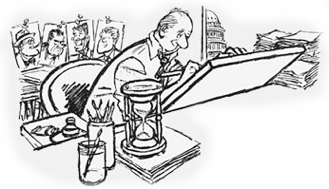 Herb Block is among the world’s best known and most admired political cartoonists. Born on October 13, 1909, the native Chicagoan spent his 72-year career fighting against abuses of the powerful.